Welcome

The goal for this project is to complete the digital and written gathering of exclusively “first voice” biographical material of 23 Women Artists and Artists of Color active in the San Francisco Bay Area from the 1950’s to the late 1960’s, when their histories were undervalued because of public and personal hegemonic social and aesthetic scrutiny. The archive will be housed at the Anne Bremer Memorial Library, San Francisco Art Institute.

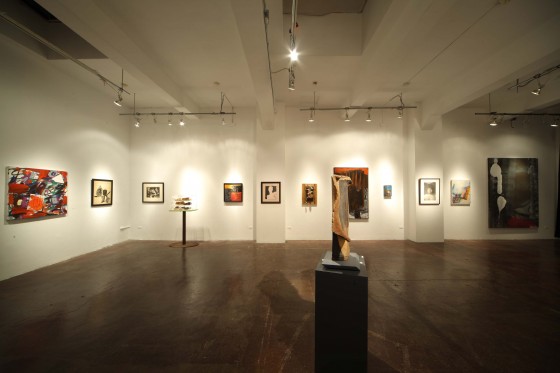
An exhibition of work by these artists is now in the planning stages for the Luggage Store Gallery, San Francisco, California.


This is an introductory statement for a recent roundtable of artists and scholars who discussed a small, productive art scene of diverse artists who were active in San Francisco between 1950 and 1970. Of the many publications historicizing work of that time, there is no mention of how different artists of color thought about their time or what their production meant to them.

“Rehistoricizing the Time Around Abstract Expressionism in the San Francisco Bay Area 1950s–1970s” can be downloaded as a brochure. This material provides a window into an important adjunct in history—the period between cultural and racial segregation in the United States and the time of Martin Luther King’s speeches and the events of civil disobedience—that led to the new pluralism of the 1970s.

Relatively, modern painting and sculpture mattered to a very few. Communities of people of color and most women were not encouraged to be a part of it. Also, issues of gay and lesbian activity were still closeted.

While Filipino American art history is still young on the West Coast, as of 2005 the manong generation is in its eightieth year. From the late 1940s to 1950s, when the first generation of American-born Filipinos came of adult age, there were few accessible artist role models that we (of that American-born generation) could look to for encouragement in the arts.

In San Francisco, if anyone happened to know of Alphonso Ossorio, Carlos Carvajal, Roberto Vallangca, Sylvestre Mateo, Frederico Jayo, Joaquin Legaspi, or Victor Duena, we considered ourselves lucky because they were doing something wondrous and different compared with (all respects) the day-to-day, mostly menial, occupations that our parents and their friends held on to with an uncommon tenacity and pride. Most of the parents from the manong generation discouraged their children from any long-term, fine arts involvement because of the obvious lack of career stability. Everyone in my father’s circle of acquaintances, as well as our friends, only thought of art as a hobby.

Growing up in the 1940s and 1950s—in day-to-day conditions outside of my family—was difficult because the ongoing (not always blatant) indifference and racial prejudice was pervasive in high schools and other citywide facilities. As intergenerational communication became more vague at home, the dreams of my father and his generation seemed distant from my own dreams. The realities of bridging two worlds—the world inside my father’s house with the non-Filipino world outside—seemed daunting.

“IF YOU ARE BLACK STAY BACK,
IF YOU ARE BROWN STICK AROUND,
IF YOU ARE WHITE YOU’RE ALRIGHT”

In the 1950s, it was ‘jokes’ like this that seemed to describe the racial climate and ‘glass enclosures’ that separated people. The code of behavior in my father’s house was like this: The white people were always the ‘authority figure’ (i.e. the landlords, landladies, bosses-in-general, nuns, priests, etc.). We were always reminded to ‘stay out of their way’ and to treat them with respect. There were not as many Filipinos in San Francisco in the 1940s or 1950s as there are now. My mother instructed me not to trust Filipinos outside of my family or their friends, unless introduced. My parents seemed closer to Chinese people then they were to other Asians, Latinos, or African Americans.

In the Sacramento/San Joaquin delta farmlands, labor gangs were made up of single racial minority groups. The white growers would have them compete with each other for harvesting jobs. At one time or another, most immigrant societies in America have been through the ‘Crab-box Syndrome’—a crab-box is half-filled with crabs and each time a crab tries to escape it is pulled back by the rest of the crabs.

Fears, suspicions, and jealousy, a sense of common roots along with dreams, pride, optimism, and a strong sense of survival kept Filipinos together during that time*.

Growing up in the house of my parents was to constantly be under an umbrella of paranoia. Meanwhile, I went to grammar and high school with everyone that I should not be associated with. The only role model I had was my cousin, Leo Valledor, an artist of the generation who was the first-born in America.

At twelve years old, Leo’s mother died and his father abandoned him. His so-called relatives also abandoned him. At that young age, he was encouraged by his art teachers to enter competitions, which he won and received very high praise. He achieved a presence in San Francisco that not many artists achieved—especially for being so young. Leo was the first Filipino artist born in America to have achieved his stature. I, in turn, as his younger cousin, was always inspired and encouraged by him. In our twenties, we both saw art as being “freedom,” and I became a painter in spite of my family’s wishes.

To my knowledge, Filipino American art history in the United States begins with Alphonso Ossorio, Carlos Carvajal, Roberto Vallangca, Joaquin Legaspi, Sylvestre Mateo, Frederico Jayo, and Victor Duena. With the exception of Ossorio, these artists were alive and making art in the San Francisco Bay Area. They were artists who were all born in the Philippines.

In 1936, Leo and I were both born in San Francisco. He attended California School of Fine Arts and was first exhibited at the age of nineteen in San Francisco at the Six Gallery in 1956, where Allen Ginsberg also read ‘Howl’ for the first time that same year.

In New York during the mid–late 1960s, Leo Valledor, Bob Duran, Mario Yrissary, and myself, exhibited abstract paintings and sculpture in solo and group exhibitions at mainstream venues. Then, in the early 1970s, young artists such as Ben Lagasca, Lee Tacang, Ray Dacanay, and Ed Caldwell exhibited, and (after the Student Rebellion) the first ever compilation of Filipino American art and poetry was constructed by the students and faculty at San Francisco State University. It was called Liwanag.

Hopefully this imperfect preface serves the purpose of describing personal experiences and an urban life condition ‘growing up’ in the 1940s and 1950s. It also serves as framework for the significance of Leo Valledor because he not only represented a Filipino American generation; he also contributed to critical dialogue in local avant-garde art circles. That is how we—as a diverse collective of individuals—became nutrient to the important future issues and interrogations of the 1970s.

At the roundtable discussion hosted by the San Francisco Art Institute on November 5, 2005, Abstract Expressionism and artists of color were among several provocative issues raised. Though subtle, these pointed to the different ‘colorings’ of abstract expression that may have been important to artists of diverse backgrounds. For example, several artists spoke about the importance of ‘freedom’ as a goal of expressionism. Dewey Crumpler proposed that freedom in art has a different historical meaning for many artists of color than for mainstream artists. In addition, issues of spirituality were also discussed. Lizzetta LeFalle–Collins suggested that the different spiritualities that arise in diverse communities also shape artistic production in distinctive ways. And, although abstract expressionism was an international and internationalist phenomenon, the work that was produced often reflected distinct specifications of artists’ international interests. Mark Johnson remarked that for many Asian American artists with an interest in exploring their heritage, an ‘East-West’ exchange can be identified in their work. These represent a few of the ways that Abstract Expressionism was personalized to reflect the histories and interests of artists of color.

—Carlos Villa, 2006


*This is the time of the manong generation—so called because of the bachelors who were here who called each other ‘manong,’ which meant ‘brother.’
*America Is in the Heart: A Personal History, by Carlos Bulosan (1973), is a good written account of the social conditions of the time.